









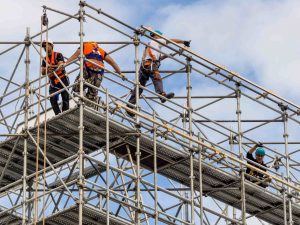
 New York’s Scaffold Law, codified in the state’s Labor Law Section 240, is primarily aimed at protecting construction workers from fall-related injuries. Enacted in the late 19th century, this law mandates strict liability for property owners/managers, construction companies, contractors and their agents when workers are injured due to falls or falling objects on construction sites. Here are four critical aspects of New York’s Scaffold Law to know and understand:
Here are four critical aspects of New York’s Scaffold Law to know and understand:
1. What the Scaffold Law covers
The Scaffold Law applies to construction, demolition, and repair projects involving
elevation-related risks. It specifically governs incidents where workers are injured due to inadequate safety measures while working at heights or beneath falling objects. Activities covered by this law include tasks such as erecting scaffolding, working on ladders, or operating at elevated platforms.
The law requires employers, property owners/managers, and contractors to ensure that workers have access to proper safety equipment such as harnesses, guardrails, and secure scaffolding. If these measures are not provided or are insufficient, and a worker is injured in a construction accident as a result, the responsible parties can be held strictly liable. This means that the injured worker does not need to prove negligence (carelessness). The victim only needs to show that the safety equipment, if any, failed to provide adequate protection.
2. What ‘strict liability’ means
A cornerstone of New York’s Scaffold Law is its imposition of strict liability on property owners/managers and contractors. Unlike in general negligence cases, where the injured party must prove the defendant’s fault, strict liability under the Scaffold Law means that employers and contractors are held responsible regardless of whether they directly caused the accident.
For example, if a worker falls from a defective ladder or is struck by an unsecured object, the property owner/manager or contractor is automatically liable if proper safety measures were not in place. This shifts the burden of proof away from the worker and focuses on whether the safety regulations were followed. While strict liability is beneficial for injured workers who might otherwise face difficulties proving fault, it is controversial. Critics argue that it leads to excessive litigation and increased insurance premiums, while advocates contend that it incentivizes employers to prioritize worker safety.
3. The role of comparative negligence
One of the most significant aspect of the Scaffold Law is its exclusion of comparative negligence as a defense. Comparative negligence allows courts to allocate fault among parties based on their contributions to the accident.
Under the Scaffold Law, however, the injured worker’s actions are generally not considered. This high threshold limits the ability of defendants to argue that the worker shared responsibility for the incident. For instance, if a worker disregards safety training or misuses equipment but the provided safety measures were inadequate, the property owner/manager or contractor can still be held liable. Proponents and safety advocates say it protects workers from being blamed for systemic safety failures beyond their control.
4. Scaffolding accidents are preventable.
Scaffolding accidents are preventable with proper safety protocols, training, and equipment. Scaffolding is essential for construction and maintenance work, but its improper use or assembly can lead to serious injuries or fatalities. The Occupational Safety and Health Administration (OSHA) has established guidelines to minimize risks, emphasizing the importance of compliance to ensure worker safety.
Proper assembly and inspection are critical in preventing these devastating accidents. Scaffolds must be erected on stable ground, fully planked and braced to prevent collapse. Regular inspections by qualified personnel can identify hazards such as weak supports or damaged components before they cause harm.
Adequate fall protection is another vital measure. Workers should always use personal protective equipment (PPE) such as harnesses and lanyards. Guardrails, toe boards, and safety nets add extra layers of protection, especially at higher elevations. Worker training plays a crucial role in accident prevention. Educating employees about scaffold safety, proper usage and recognizing risks ensures that everyone on-site is equipped to avoid dangerous situations.
Contacting an Experienced Lawyer
Many construction workers in New York City such as ironworkers, steelworkers,
carpenters, masons, bricklayers, painters, window washers, and electricians etc. suffer serious or even fatal injuries when they fall from an elevation. Typically such workers perform their tasks while on roofs, scaffolds, ladders, platforms, etc. Workers who fall from a roof may suffer devastating head injuries, multiple broken bones or even paralysis as a result of spinal cord trauma.
If you or a loved one has been injured in a construction accident, the experienced New York personal injury attorneys at the Law Offices of Kenneth A. Wilhelm can help you better understand your legal rights and options. For over 53 years, our skilled accident attorneys have established a proven track record of helping injured victims get fair compensation for their losses. Our law firm recovered $3,375,576 for a construction worker (an undocumented immigrant) who was injured on the job — one of the highest construction case settlements in New York that year. Also, one of our clients obtained a verdict for $43,940,000 and another of our clients got a verdict for $23,500,000, both in medical malpractice cases.
Please contact us TOLL FREE 24 hours a day, 7 days a week at 1-800-WORK-4-YOU (1-800-967-5496). WE CAN EVEN COME TO YOU. There is no attorneys’ fee unless we recover money for you. We can also help with personal injury, lead poisoning and medical malpractice cases including, brachial plexus palsy (Erb’s palsy) and cerebral palsy cases in New York, New Jersey, Connecticut, Pennsylvania, or Florida. If you have been seriously injured in any of the 50 U.S. states, please call us and we will try to help you with your case.
Other TOLL FREE phone numbers for us are:
1-800-RADIO-LAW, 1-888-WYPADEK, OR 1-800-LAS-LEYES
Please visit us at: www.WORK4YOULAW.com