













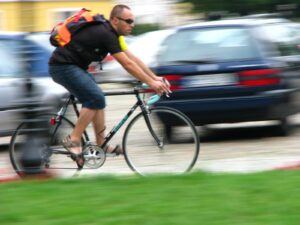
 Bicycle helmets are an essential and potentially life-saving accessory for cyclists, playing a crucial role in reducing the impact of accidents and the severity of injuries. The importance of wearing bicycle helmets cannot be overstated, considering the vulnerability of bicyclists on roadways. Helmets act as a crucial line of defense against traumatic head injuries, including concussions, skull fractures, and traumatic brain injuries, which are among the most severe consequences in a bicycle accident.
The structure and design of helmets are specifically engineered to absorb and dissipate the force of impact, thereby safeguarding the bicyclist’s head. Beyond head protection, bicycle helmets also contribute to minimizing facial injuries, abrasions and fractures. A number of studies done by researchers over the decades show beyond doubt that bicyclists are always better protected when they wear a helmet.
What Studies Tell Us
According to the U.S. Centers for Disease Control and Prevention (CDC), head injuries occur for one out of three bicyclists involved in non-fatal accidents. Trauma to the head also poses the greatest risk of death and disability for bicyclists. One CDC study found that bicycling resulted in the highest number of sports-related traumatic brain injuries. These types of head injuries have the potential to cause lasting health issues. They also often result in death.
Studies have also shown that while helmets may not protect against head injuries such as concussions, they have consistently proven to reduce severe head injury and death for cyclists. A Norwegian researcher who reviewed more than 100,000 bicycle accidents, found that helmets reduced the risk of serious head injuries in riders by about 60%.
Another analysis of 6,267 patients admitted to hospitals for brain bleeds after bicycle accidents found that those who were wearing helmets had a 51% lower risk of developing a severe traumatic brain injury and an overall lower death rate. Data from 2012 shows that among 863 adult bicyclists surveyed that year in the U.S., more than half reported that they did not wear helmets while riding. In many cases, bicyclists who sustained head injuries said they were not wearing helmets at the time, according to a University of Washington study.
How Helmet Design Helps Prevent Injuries
Researchers who have studied this issue maintain that the protection helmets provide is undeniable, even if bicycle helmets may not be a sought-after or even desired accessory, especially for adult riders. The key to why they are so effective is in their design. Most bicycle helmets consist of an outer polycarbonate shell surrounding a layer of expanded polystyrene foam, commonly known as Styrofoam, with padding on the innermost surface. When there is impact, the hard shells deforms and cracks, distributing energy across the helmet. The foam compresses, absorbing more impact. This helps ensure that the head absorbs the least amount of force.
With recent advances in neuroscience, bicycle helmet technology has only improved. While conventional helmets were designed to protect against direct or linear impacts, modern helmets are also designed to protect against impacts that occur at off angles. University of Washington researchers published a review of 12 studies testing the effectiveness of new and conventional helmet technology. They found that newer helmet designs reduced brain injury more than conventional helmets.
Role in Injury Prevention
In addition to head injuries, bicycle helmets help prevent:
Facial injuries: Bicycle helmets protect against injuries to the face and victims wearing helmets are less likely to sustain facial lacerations, abrasions, and fractures. Helmets not only safeguard the head but also provide a level of protection for the face, reducing the risk of disfiguring injuries.
Spinal injuries: Helmets may have a broader impact on injury prevention, possibly through altering the dynamics of the accident or influencing the rider’s posture during a fall. This might help prevent catastrophic spinal injuries that can affect one’s neck and back.
Contacting an Experienced Lawyer
If you or a loved one has been injured in a bicycle accident or pedestrian accident, or if you have lost a loved one in an auto accident caused by a negligent (careless) driver, the experienced personal injury attorneys at the Law Offices of Kenneth A. Wilhelm can help you better understand your legal rights and options, and also fight hard to recover just compensation for you.
For over 53 years, our skilled accident attorneys have established a proven track record of helping injured victims get fair compensation for their losses. Our law firm recently recovered $5,600,000 for a bicyclist who was hit by a van, and $2,550,000 for another victim of a truck accident, and $3,000,000 for a pedestrian who was hit by a car, and $2,000,000 in a hit-and-run accident, and the full $1,000,000 insurance policy for a pedestrian who was hit by a truck, and $4,625,000 for a driver who was in a car and was hit by a van, and $2,500,000 for a man who fell through an improperly secured hole.
We also obtained $295,000 out of a $300,000 insurance policy in compensation for the victim of a bicycle dooring accident (where a car door opens into the path of a bicyclist). Also, one of our clients obtained a verdict for $43,940,000 and another of our clients got a verdict for $23,500,000, both in medical malpractice cases.
Please contact us TOLL FREE 24 hours a day, 7 days a week at 1-800-WORK-4-YOU (1-800-967-5496). WE CAN EVEN COME TO YOU. There is no attorneys’ fee unless we recover money for you. We can also help with personal injury, lead poisoning and medical malpractice cases including, brachial plexus palsy (Erb’s palsy) and cerebral palsy cases in New York, New Jersey, Connecticut, Pennsylvania, or Florida. If you have been seriously injured in any of the 50 U.S. states, please call us and we will try to help you with your case.
Other TOLL FREE phone numbers for us are:
1-800-RADIO-LAW, 1-888-WYPADEK, OR 1-800-LAS-LEYES
Please visit us at: www.WORK4YOULAW.com