









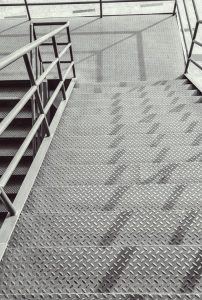
 Stairway accidents that result from the negligence (carelessness) of a property owner or property manager can potentially lead to serious injuries or even death. Property owners and managers have a legal and moral responsibility to ensure that their stairways are safe for public use. However, when they fail to meet this obligation, accidents can occur. The negligence (carelessness) in question often stems from poor maintenance, lack of safety features, or ignoring building codes and safety standards.
One of the most common causes of stairway accidents due to property owner or manager negligence is the failure to maintain stairs properly. Regular maintenance is imperative for ensuring the safety and usability of any stairway. When stairs are neglected, they can deteriorate and pose significant risks to users.
Here are some examples of how poor maintenance can lead to accidents:
- Worn or damaged treads: Stair treads, which are the horizontal parts of stairs where users place their feet, can become worn over time. As stair treads wear down, they lose traction, making it easier for individuals to slip and fall. Property owners and managers have a responsibility to regularly inspect treads and replace them when they become smooth or damaged. Failing to do so increases the risk of slips and trips, especially on stairs that are frequently used by tenants, customers, or visitors.
- Loose or broken steps: When steps break or become loose due to age, wear and tear, or environmental factors, they could create a serious hazard. A step that shifts when weight is applied or that breaks under pressure can cause a person to fall, resulting in injury. Property owners and managers must make sure that stairs are structurally sound and that any signs of damage are addressed promptly
- Accumulation of debris: A poorly maintained stairway may also accumulate debris such as leaves, dirt, or trash, which can create a tripping or slipping hazard. Outdoor stairways are especially vulnerable to this problem, particularly in environments where weather conditions contribute to debris buildup. Property owners/managers are responsible for keeping stairways clear of such hazards. Neglecting to regularly clean and inspect stairs can lead to accidents, especially during inclement weather when wet leaves or mud make steps even more slippery.
Unsafe Stair Designs
Stair accidents caused by negligence (carelessness) often involve stairs that were improperly designed or constructed. Property owners and managers may either be unaware of these design flaws or choose not to address them due to the cost of repairs. However, unsafe stair designs increase the risk of accidents and should be corrected. For example, consistency in step height is crucial for user safety. When the rise (the vertical distance between steps) is uneven, people are more likely to trip or misstep because their natural walking rhythm is disrupted. Building codes typically require uniform riser heights, but in some cases, older buildings may have stairways that do not comply with current regulations. Property owners and managers should take steps to retrofit or modify stairs to meet safety standards. Ignoring this issue is a clear example of negligence that can lead to serious accidents.
Stairs that are too narrow for safe passage can lead to accidents, especially when multiple people are using them simultaneously. Narrow stairs provide less room for foot placement, which increases the likelihood of someone tripping or misjudging their step. In some cases, older buildings may have narrow staircases that do not meet modern safety requirements. Property owners and managers must ensure that stairways are wide enough to accommodate the expected traffic and meet legal standards.
Inadequate Lighting
Another significant cause of stairway accidents due to property owner/manager negligence (carelessness) is inadequate lighting. Proper lighting is essential for stair safety because it allows users to clearly see the steps, any obstacles, and the handrails. When lighting is insufficient, users are more likely to misjudge the height of a step, trip on debris, or fail to see a hazard. Property owners and managers must ensure that stairways, both indoor and outdoor, are adequately lit to prevent accidents.
One of the most common examples of poor lighting linked to negligence (carelessness) is when stairwells or staircases have dim lighting or burned-out bulbs. Staircases that are poorly lit pose a significant risk because users may not be able to see clearly where they are stepping. In some cases, property owners/managers may delay replacing burned-out bulbs to save costs or due to a lack of attention, but this simple oversight can lead to accidents, especially at night or in enclosed stairwells.
Absence of Safety Features
Neglecting to install and maintain safety features such as handrails, non-slip surfaces, and signage can also lead to stairway accidents. These features are critical for preventing falls, and their absence is a clear sign of property owner or manager carelessness. For example, handrails are essential for helping individuals maintain their balance while using stairs. When stairs lack handrails or have handrails that are loose, improperly installed, or difficult to grip, the risk of accidents increases.
Stairs with smooth surfaces are particularly dangerous because they can become slippery when wet, leading to falls. Property owners and managers can mitigate this risk by installing non-slip materials on stair treads, especially in areas prone to moisture, such as outdoor staircases or those near kitchens and bathrooms. Failing to do so demonstrates negligence, particularly if accidents occur during rainy or snowy conditions when stairs are more likely to become hazardous.
Contacting an Experienced Lawyer
Property owners and/or property managers can be held liable for stairway accidents. They may also be held responsible if tenants, visitors or guests to their property are injured in a slip-and-fall or trip-and-fall accident. If you were involved in a slip-and-fall or a trip-and fall accident as a result of someone else’s negligence (carelessness), please remember that you have rights. Some of the damages that victims of such accidents can claim include, but are not limited to, medical expenses, loss of wages and benefits, cost of hospitalization, surgery, physical therapy, past and future pain and suffering, permanent injury, etc.
The experienced personal injury attorneys with the Law Offices of Kenneth A. Wilhelm can help you better understand your legal rights and options and also fight hard to recover just compensation for you. For over 53 years, our skilled attorneys have established a proven track record of helping injured victims.
Our law firm recovered $1,700,000 for a woman who slipped and fell and received no hospital or medical treatment for one month after the accident. We recently recovered $5,600,000 for a bicyclist who was hit by a van, and $2,550,000 for another victim of a truck accident, and $3,000,000 for a pedestrian who was hit by a car, and $2,000,000 in a hit-and-run accident, and the full $1,000,000 insurance policy for a pedestrian who was hit by a truck, and $4,625,000 for a driver who was in a car and was hit by a van, and $2,500,000 for a man who fell through an improperly secured hole. Also, one of our clients obtained a verdict for $43,940,000 and another of our clients got a verdict for $23,500,000, both in medical malpractice cases.
Please contact us TOLL FREE 24 hours a day, 7 days a week at 1-800-WORK-4-YOU (1-800-967-5496). WE CAN EVEN COME TO YOU. There is no attorneys’ fee unless we recover money for you. We can also help with personal injury, lead poisoning and medical malpractice cases including, brachial plexus palsy (Erb’s palsy) and cerebral palsy cases in New York, New Jersey, Connecticut, Pennsylvania, or Florida. If you have been seriously injured in any of the 50 U.S. states, please call us and we will try to help you with your case.
Other TOLL FREE phone numbers for us are: 1-800-RADIO-LAW, 1-888-WYPADEK, OR 1-800-LAS-LEYES
Please visit us at: www.WORK4YOULAW.com